Buying from a pemborong kurma Selayang means picking a variety, a grade and a price per kilo. This guide starts one step earlier, with the tree. The date palm is an odd fruit tree in several ways, and a few of those quirks help explain the trade, such as why very soft dates are kept cold. Dates sold in Malaysia are all imported, since Malaysia has no commercial date-growing trade, so every pack on a wholesaler's shelf in Selayang began on a palm somewhere else. Kurma Mariami from Iran is used as the worked example, with real pack prices further down.
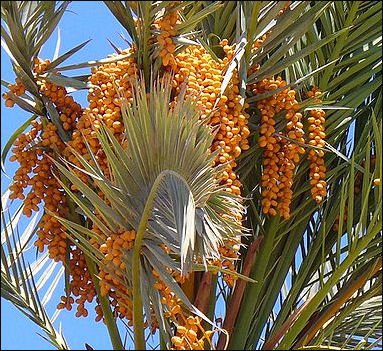
Male palms and female palms
FAO's handbook Date Palm Cultivation (Plant Production Paper 156, Rome 2002) describes it as a dioecious species, with male and female flowers produced on separate palms. Only the female palms bear dates.
That has a practical cost. If you grow date palms from seed, about half the seedlings turn out male, and there is no reliable way to tell which is which until the palm flowers, often around seven years later. FAO adds that fruit from seedling palms is usually late, variable and generally of lower quality than fruit from established clonal palms. In a seedling plantation, the handbook says, it is rare for more than one palm in ten to produce fruit of satisfactory quality.
Growers pollinate the flowers themselves
Wind, bees and insects can pollinate date palms, and FAO notes that this natural pollination gives a fair fruit set in some areas, for example Marrakech in Morocco and Elche in Spain. Those groves are all seedling palms, with roughly half of them male. Without pollination, the female flowers develop into fruit with no commercial value.
FAO states plainly that commercial date production requires artificial pollination, either by the traditional hand method or with mechanical devices. Because pollen is applied deliberately, a modern plantation needs very few male palms: the handbook gives a ratio of one male to every fifty females.
New palms come from offshoots
FAO lists producing offshoots as one of the traits that set the date palm apart from two of its Phoenix relatives, the ornamental Canary Island palm and P. sylvestris. Offshoots are young palms that grow from buds at the base of the trunk. They matter because an offshoot is true to type: its fruit has the same quality as the mother palm. Planted out, it bears fruit 2 to 3 years earlier than a seedling.
The supply of offshoots is limited, though. A palm produces 20 to 30 of them at most, mainly in its first 10 to 15 years after planting, and only three or four are ready to plant out in any one year. Each still spends 1 to 2 years in a nursery before going to the field. This is how a named variety keeps its character from one generation of palms to the next. Seed-grown palms are not true to type, and FAO notes that no two seedlings are alike.
Heat, little rain, and a lot of irrigation water
Date palms are grown in arid and semi-arid regions with long hot summers, little or no rainfall and very low humidity while the fruit ripens. FAO says a palm under irrigation can endure exceptional heat of around 56°C for several days. Growth stops below 7°C, is at its best at about 32°C, and starts to slow once the temperature passes 38°C to 40°C.
Desert tree does not mean dry roots. The same handbook gives water figures for Deglet Nour palms at Tozeur in Tunisia: about 7,154 m³ per hectare across July, August and September, against 4,372 m³ per hectare across December, January and February. Summer needs are almost double the winter ones. The rain is missing, so growers supply the water.
| Trait | What FAO describes | Why a buyer might care |
|---|---|---|
| Sexes | Male and female flowers on separate palms | Only female palms give fruit |
| Pollination | Commercial production requires artificial pollination; about 1 male per 50 females in a modern plantation | Fruit set depends on the grower's work, not just the weather |
| New palms | Offshoots are true to type; 20 to 30 per palm at most | A named variety stays the same variety |
| Climate | Long hot summers, little or no rain, low humidity during ripening | Malaysia has no commercial date-growing trade |
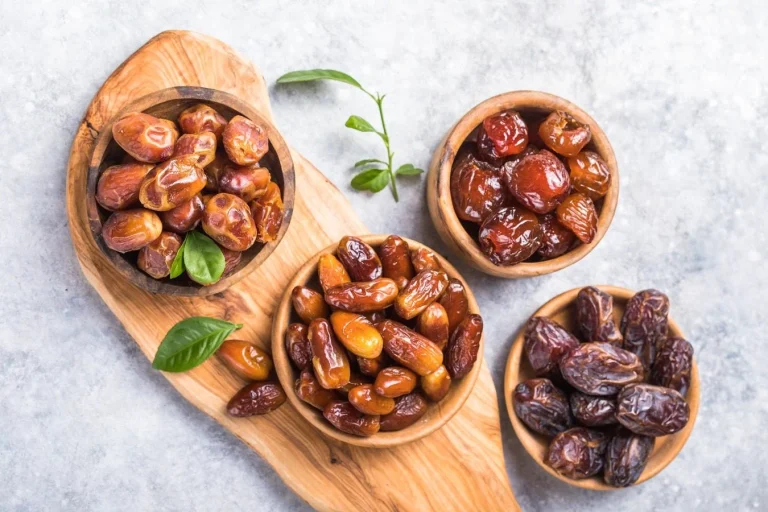
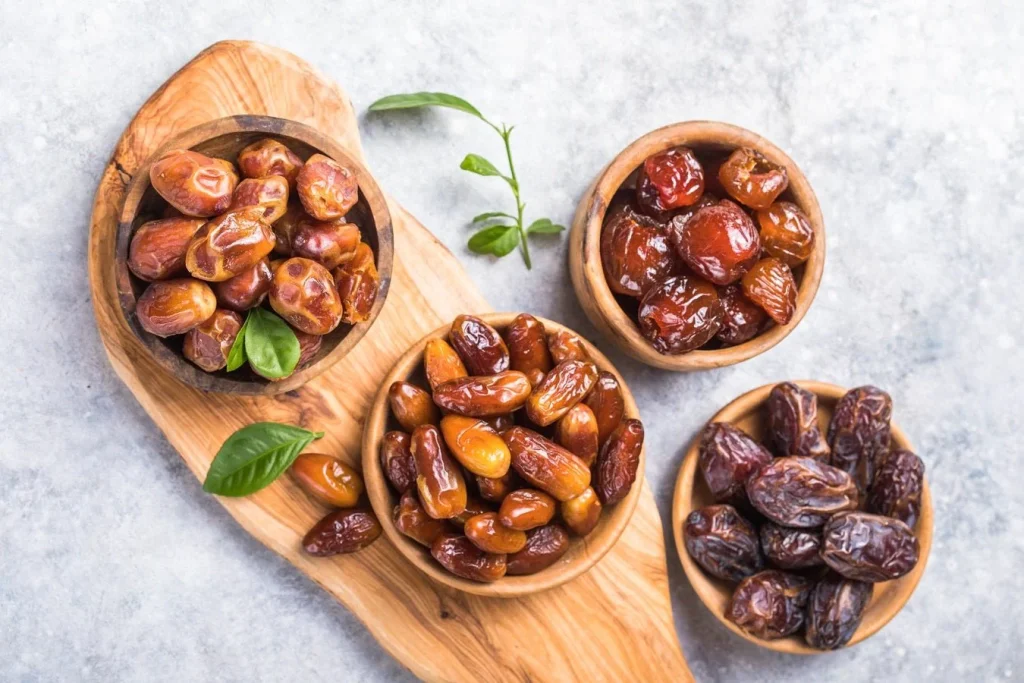
| Fruit range | 2 to 60 g per fruit, yellow to black, soft to dry | Varieties differ a lot in size, colour and texture |
From green fruit to the date in the pack
FAO splits fruit development into five stages: hababouk, kimri, khalal, rutab and tamar. At kimri the fruit is hard, apple green and not fit to eat. At khalal it turns yellow, pink, red or scarlet depending on the variety and reaches its full size. Rutab is the soft ripe stage, when the tip turns brown or black and softens. Tamar is fully ripe: the fruit has lost most of its water, the skin wrinkles as the flesh shrinks, and the colour darkens over time.
The storage point is the one to remember. FAO says dates at every stage except tamar are perishable because of their high water content, and that rutab fruit turns sour quickly unless it is cold stored. Tamar is described as the best condition for storage. Mazafati is the familiar Malaysian example: a very soft, high-moisture date that needs refrigeration and is cold-stored so it can be sold year-round. The site's post on long-term storage of dates goes further into that side.

Kurma Mariami as the example
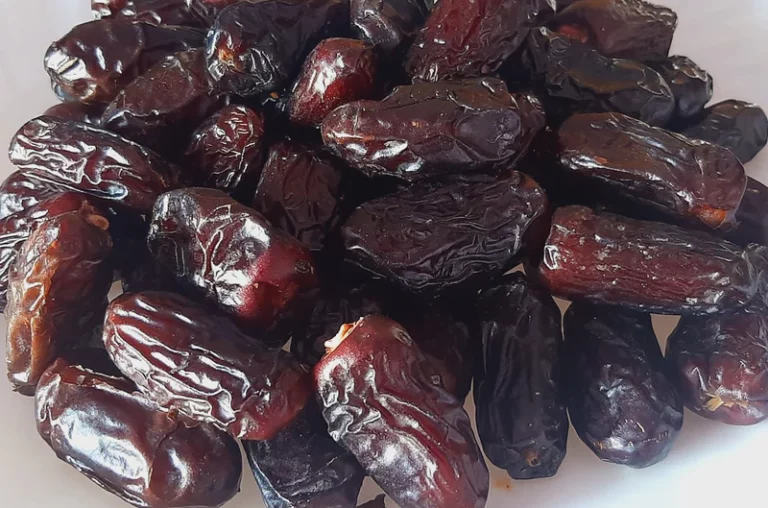
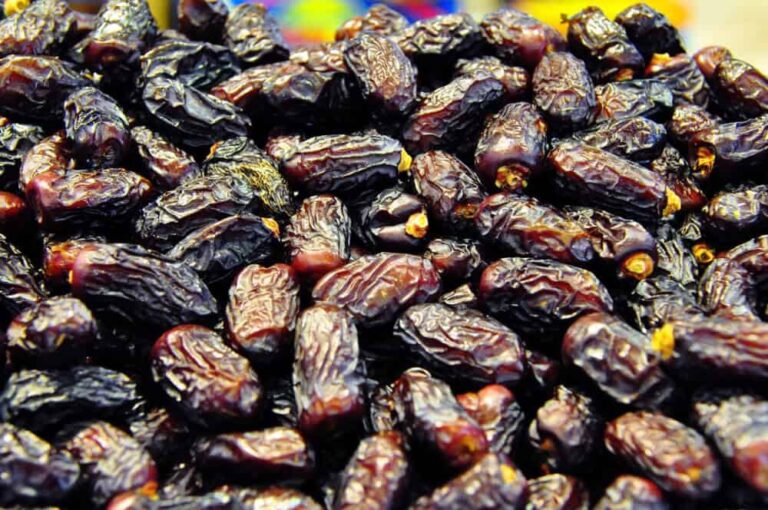
FAO counts more than 3,000 date varieties worldwide, about 400 of them in Iran. Kurma Mariami is one of the Iranian varieties sold in Malaysia: a dark, semi-dry, chewy date. Piarom is a different variety, so the two names should not be read as one. If you want to trace where a pack comes from, the post on tracing kurma origin is a good next read.
Grades such as A, AA, AAA and Jumbo are not an international standard. Each importer sorts its own stock by size, so the newer post on Mariami grades and packs is worth reading before you compare two suppliers.
Kurma Mariami prices from one Malaysian wholesaler
These are the Mariami packs on one Malaysian wholesaler's list, checked in November 2026. Per-kilo figures appear only for 1 kg and 5 kg packs.
| Pack | Total weight | Price | Per kg | Stock (Nov 2026) |
|---|---|---|---|---|
| Mariami A Normal 2026 [5kg] | 5 kg | RM75 | RM15 | In stock |
| Mariami AA 2026 [5kg] | 5 kg | RM129 | RM25.80 | In stock |
| Mariami AAA VIP 2026 [5kg] | 5 kg | RM148 | RM29.60 | In stock |
| 1kg Mariami AAA | 1 kg | RM40 | RM40 | In stock |
| Mariami A no.2, 5kg | 5 kg | RM68 | RM13.60 | Out of stock |
| Mariami AA, 5kg (No.2) | 5 kg | RM80 | RM16 | Out of stock |
| Mariami Jumbo Premium Box, 500g × 12pcs | 6 kg | RM235 | n/a | Out of stock |
| Mariami AA Pouch Bag, 400g × 12pcs | 4.8 kg | RM153 | n/a | Out of stock |
| Mariami AA Pouch Bag 2026, 200g × 24pcs | 4.8 kg | RM147 | n/a | Out of stock |
Four packs were in stock when checked, and all of them are either 1 kg or 5 kg. In the in-stock 5 kg packs the price rises with the grade label, from RM75 for A Normal to RM129 for AA and RM148 for AAA VIP. The gap between the cheapest and dearest in-stock 5 kg packs is RM73.
The 1 kg AAA pack at RM40 is the only small pack in stock. Note that its grade is plain AAA, not AAA VIP, so it is not a straight small-pack version of the RM148 5 kg pack. The No.2 packs, the Jumbo box and both pouch packs were all out of stock. There is more on the money side in how date pricing and profits really work.
Questions to ask a pemborong kurma in Selayang
Whether you buy from a shop in Selayang or order from further away, the useful questions are the same. Which variety is it, and which country does the label name? What does this seller's grade label mean in size? What is the total weight of the pack, and the price per kilo? Is it in stock now, or only listed?
Timing matters too. Demand for dates peaks before and during Ramadan, with other peaks around Hari Raya, weddings (hantaran), kenduri and umrah gifts. If you are buying kurma Mariami for one of those, ask about stock well before the rush.
Short answers
Are dates grown commercially in Malaysia?
No. Malaysia has no commercial date-growing trade, so every date sold here, kurma Mariami included, is imported.
Do date palms need much water?
They need little rain but plenty of irrigation. FAO's Tozeur figures put summer water needs at almost double the winter needs.
Is Piarom another name for this date?
No. Piarom is a separate Iranian variety with its own name.
Why are some soft dates kept cold?
FAO says dates before the tamar stage are perishable because of their high water content, and rutab fruit sours quickly unless cold stored.